Specify the load
Map tenant MW and white-space needs to Power Cell and Data Cell counts—stamp envelopes first, pad plan second.

System · Pad flow
GridCell sites are not megaproject timelines with a power story bolted on. Power Cells, site bus, and Data Cells are designed as one pad grammar—factory-built, then scaled block by block.
System flow
From pipeline fuel through generation and storage, onto the site bus, into Data Cell white space—and out as AI compute load.
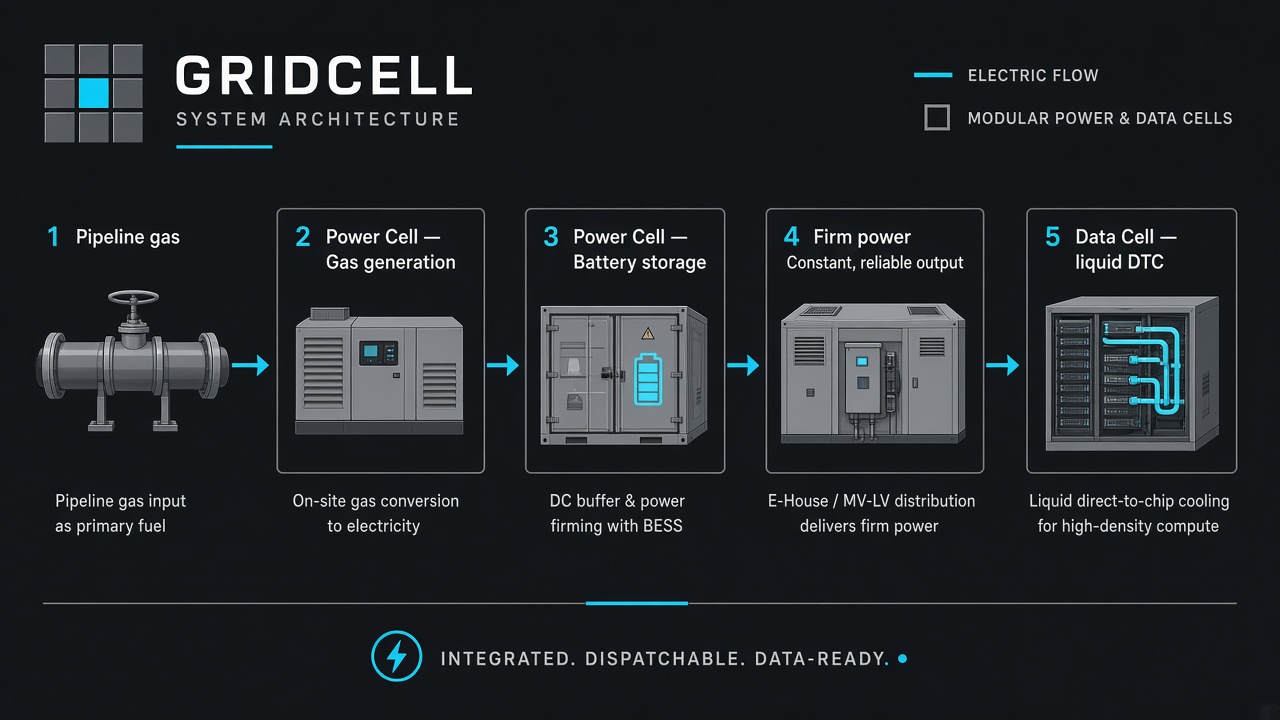
Pipeline natural gas arrives at the pad—US pipeline / midstream natural gas without baseload liquid-fuel logistics.
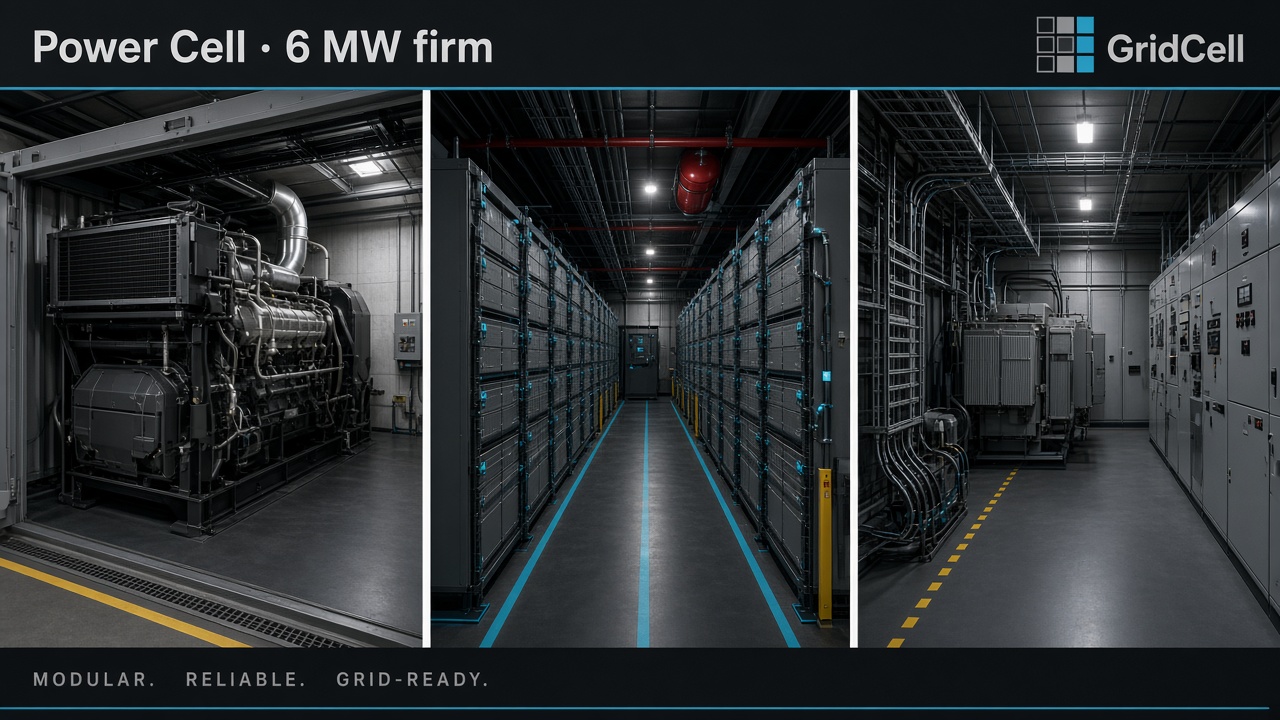
N+1 gas gensets (3+1) plus a grid-forming BESS produce ~6 MW firm facility capacity per 5 MW Data Cell. On power-ready sites the utility interconnect replaces the gensets. The E-House / MV switchgear presents a clean electrical interface.
Pad-level distribution routes capacity to Data Cells and shared plant loads with repeatable interfaces.
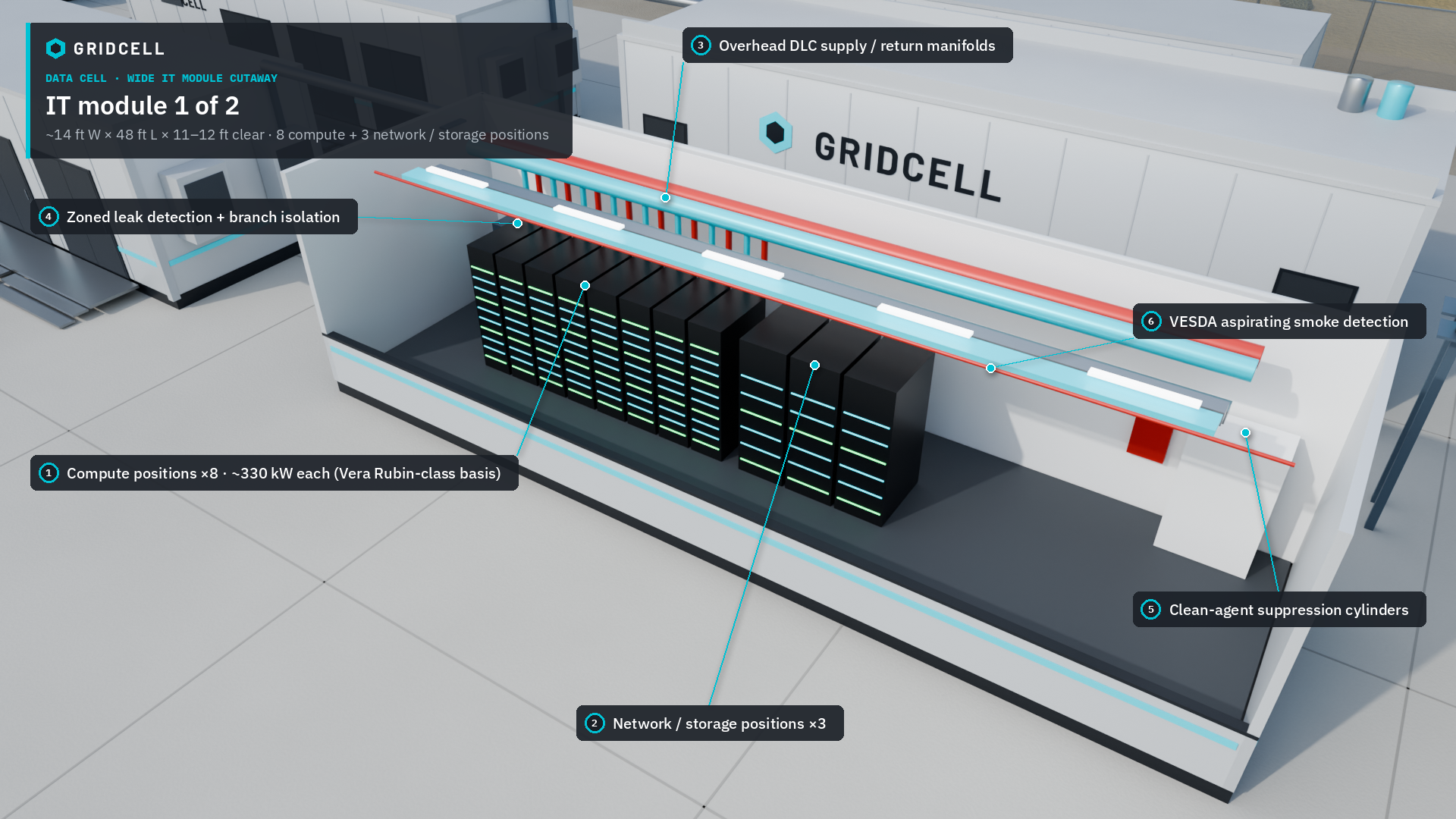
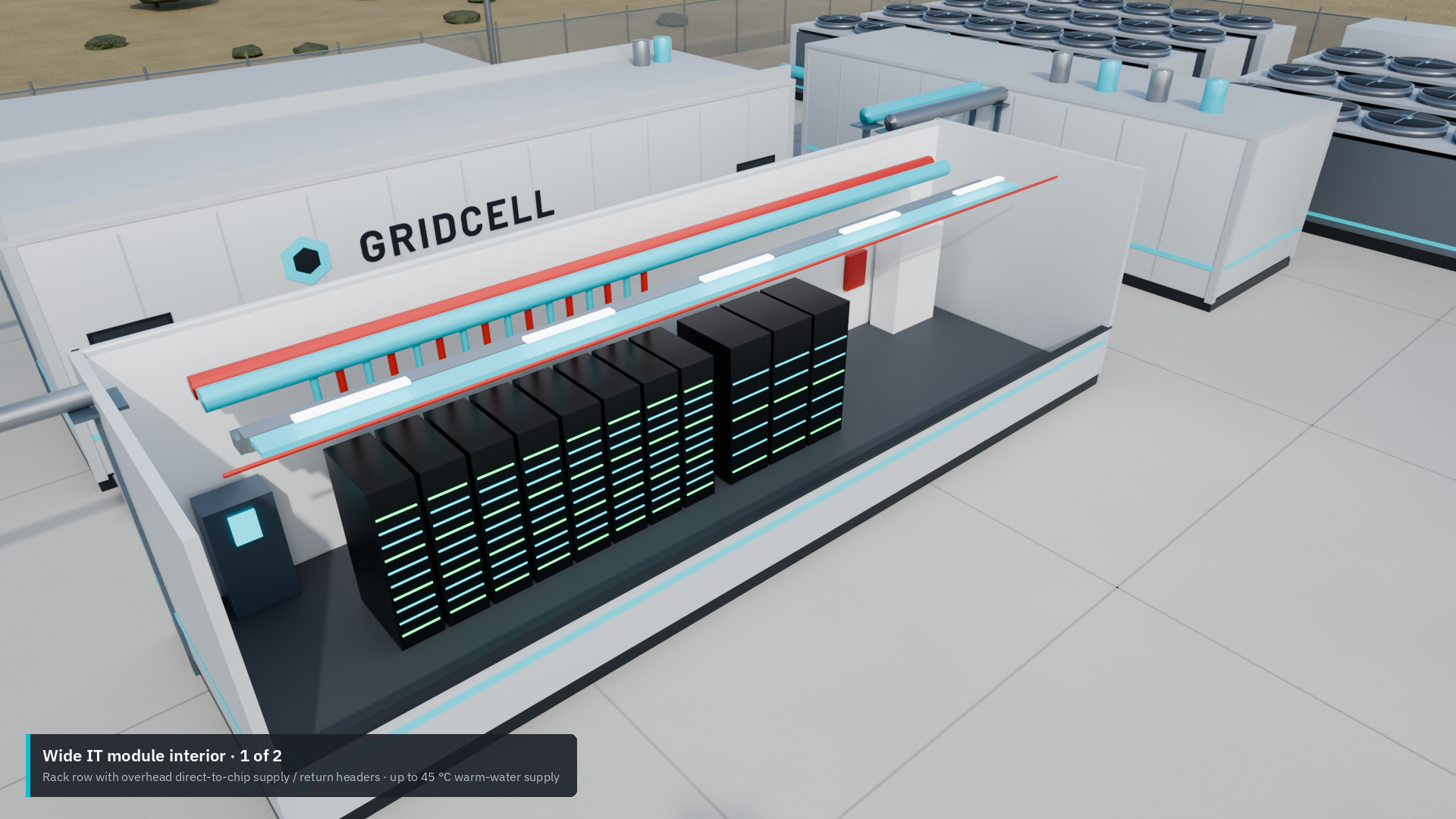
A 5 MW liquid-cooled cell designed for NVIDIA Vera Rubin-class rack-scale systems, delivered as about 14 modules: 2 wide IT modules (16 compute + 6 network positions at a 330 kW basis), CDU, electrical, network, and 7 dry coolers + 1 trim chiller. It is energized next to a matched ~6 MW firm Power Cell.
Pad composition
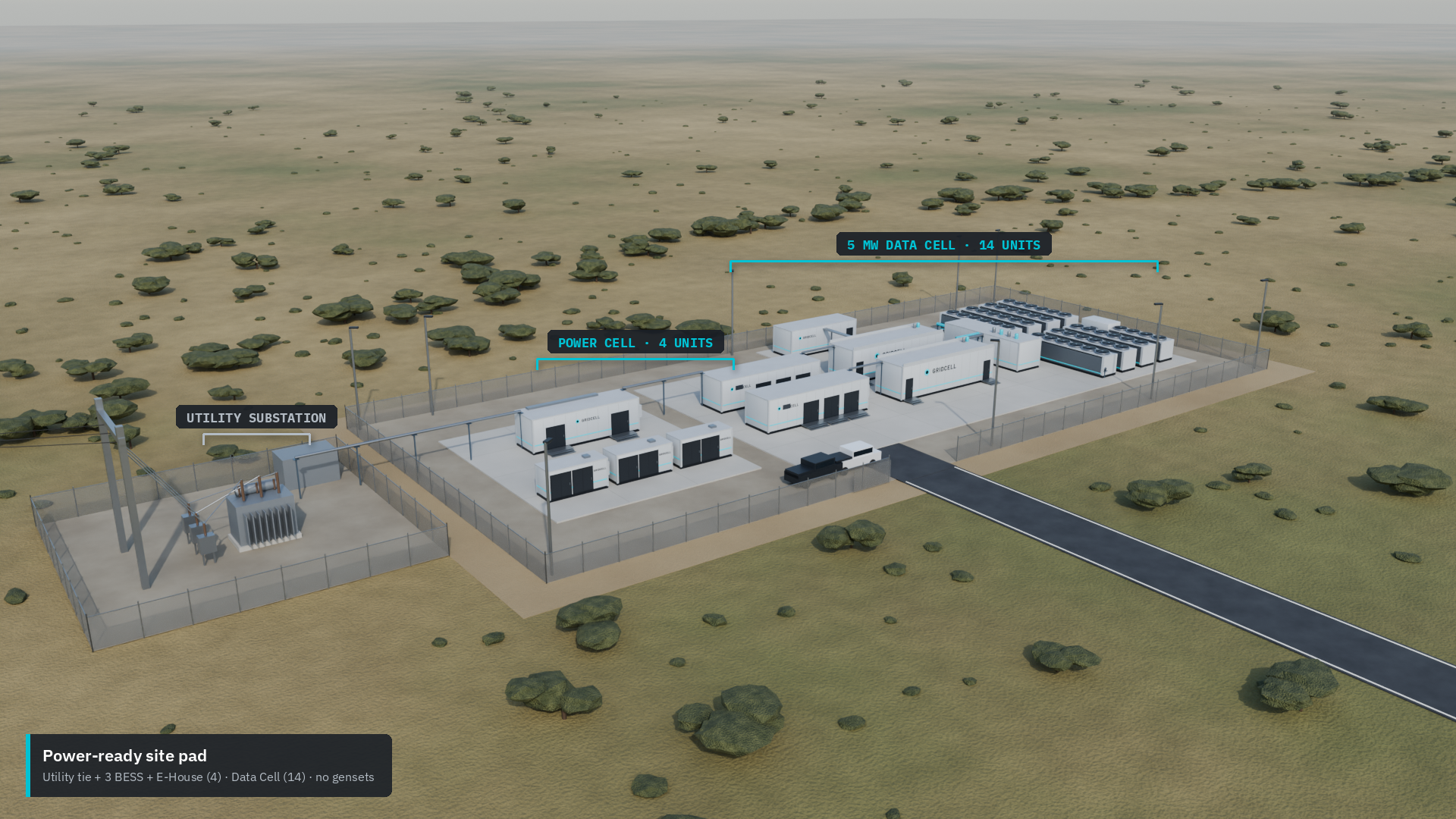
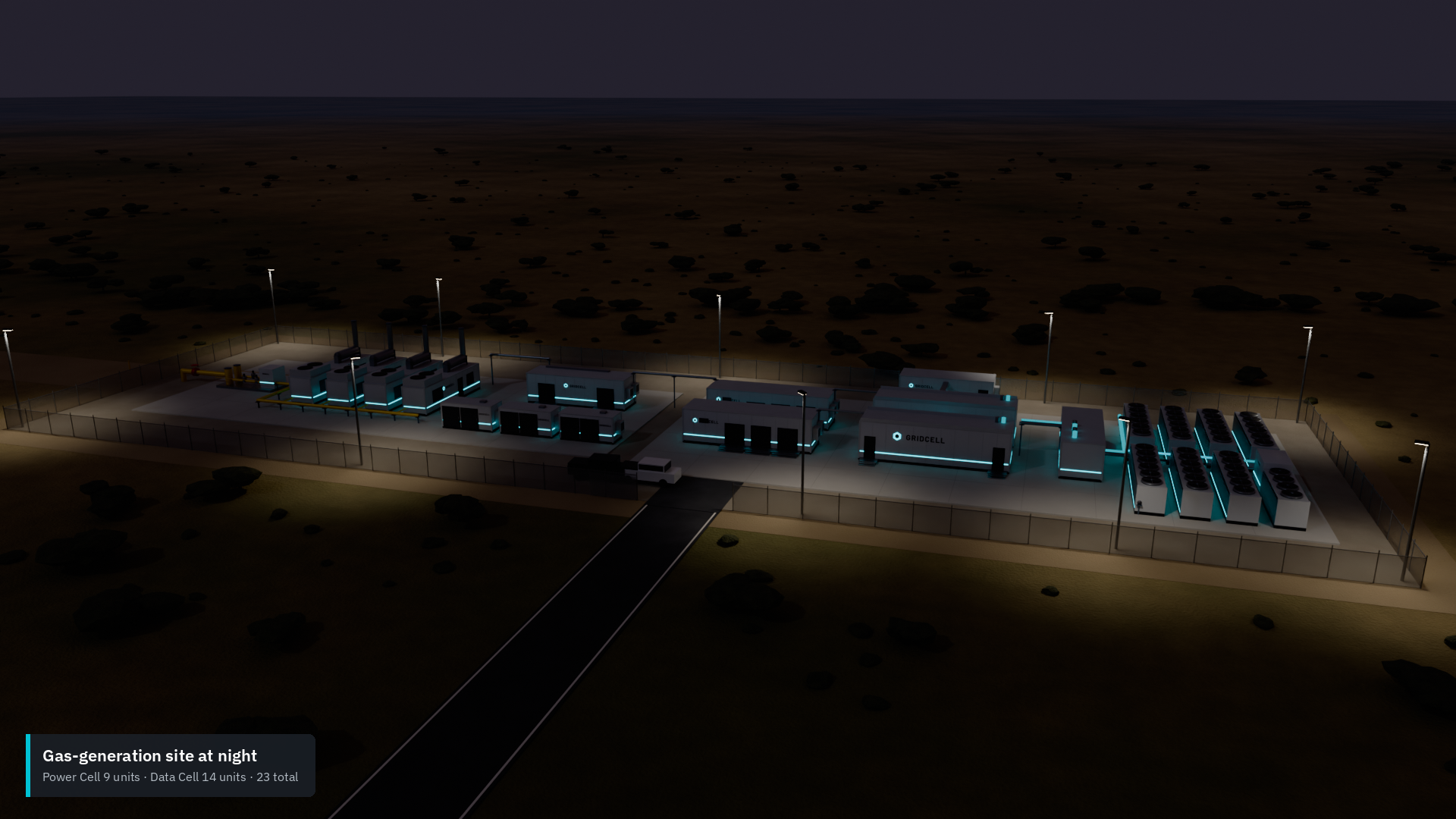
A Power Cell and a Data Cell land side by side as one matched set of modules: 23 units on a gas site (9 Power + 14 Data) or 18 units on a power-ready site (4 Power + 14 Data, next to the utility substation). The pad grows by adding matched cells, not by redesigning a megacampus every time a tenant needs another 5 MW.
The deployment pattern is consistent across the US: gas access, factory-built modules, and institutional delivery for AI tenants and capital partners.
Two commercial site types: Gas-generation (gas metering skid + 4 gensets N+1 + 3 BESS + E-House, then the Data Cell, for island / thin-grid / behind-the-meter sites) or Power-ready (3 BESS + E-House + Data Cell when the utility already delivers ~6 MW firm). Configure either on the Order page.
Detail gallery
Pad aerials above; close-ups below: the pad at night plus Power and Data interiors.
Delivery
Map tenant MW and white-space needs to Power Cell and Data Cell counts—stamp envelopes first, pad plan second.
Build generation, BESS, E-House, and the ~14 Data Cell modules off-site in parallel. The wide IT modules ship as oversize permit loads, not ISO containers. Field work stays foundations, piping, interconnect, and commissioning.
Energize the first cells, prove the interfaces, then add capacity one block at a time as AI demand grows.
Power Cell / Data Cell briefs, site pad inquiries, or introductions for AI tenants and capital partners.